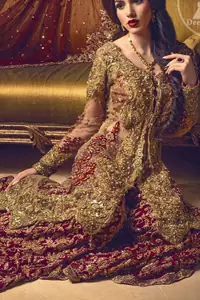
A Sharara holds visual authority at a Mehndi because it creates vertical flow without breaking the leg line. Unlike a Gharara, the Sharara flares from the waist in one continuous movement. In a Liverpool Mehndi, this matters. The body appears lengthened. The silhouette reads cleanly from distance. This is essential in a Ball Room where scale exaggerates imbalance.
Khala’s verdict is clear. A Sharara dictates posture by forcing even weight distribution. When the waist is supported correctly, the torso lifts naturally. Shoulders settle. Movement becomes economical.
The golden rule for a Mehndi is this: if the Sharara does not fall cleanly from the waist, no amount of embroidery will save it.
Ball Rooms introduce specific failure points. Flooring is smooth and reflective. Seating compresses fabric repeatedly. Heat accumulates quickly. A Net Sharara must remain light enough to manage temperature while resisting collapse. In Liverpool, where Ball Rooms are often expansive, excessive volume causes drag and visual heaviness. The flare must be calibrated, not exaggerated.
Is a sharara the same as a lehenga or palazzo?
No. A Sharara is constructed as two flared legs joined at the waist, not a circular skirt like a lehenga or a straight fall like a palazzo. This structure allows controlled flare without rotational drag. In a Mehndi setting, this means easier walking, cleaner turns, and less resistance against the floor.
Movement exposes construction. During a Mehndi, Net should sway and then recover. It should flare gently when turning and recoil into place when still. It must never collapse around the ankles. This answers the key confusion between silhouettes. A Sharara is not decorative nostalgia. It is functional tradition when built correctly.
At Deemas Fashion, internal canvas layers are inserted at the waist and reinforced seams are used at flare junctions. This prevents downward creep caused by dense hand embroidery. The Sharara moves with the body instead of fighting it. Tradition remains practical because it is engineered deliberately.
- High filament Net selected to prevent leg cling.
- Net thread count tested for recovery after compression.
- Grip Silk lining used to avoid itching.
- Atal lining avoided due to heat retention.
- Canvas reinforcement at waistband.
- Bukram width adjusted to support Sharara flare.
- Hem weighted to control swing.
- Zardozi anchored with double locking stitches.
- Seam strength increased at inner leg.
- Inner panels softened for prolonged wear.
- Waist hooks reinforced for movement stress.
| Fabric Type |
Weight Class |
Ball Room Risk Factor |
Drape Character |
| Net |
Light |
Low |
Fluid |
| Raw Silk |
Medium |
Medium |
Structured |
| Velvet |
Heavy |
High |
Stiff |
| Organza |
Light |
Medium |
Crisp |
Body architecture determines whether a Sharara flatters or overwhelms. Pear shapes benefit from controlled flare that balances the hip. Apple shapes must avoid dense embroidery at the waist. Hourglass frames can carry balanced hand work easily. Petite women should avoid excessive volume. It shortens the frame. Opt for a Sharara with moderate flare to elongate the body. Tall women can carry deeper flare without distortion.
Is a sharara considered formal enough for a Walima or Nikah ceremony
Yes, when constructed correctly. Formality is dictated by fabric quality, embroidery discipline, and fit. Net Shararas with refined hand embroidery transition easily from Mehndi into Nikah or Walima with styling adjustments. Colour depth and jewellery selection complete the shift. A well built Sharara does not retire after one event. It adapts. Pair it with a heavier top or structured dupatta for later ceremonies. This is how investment dressing works. For brides planning cross event continuity, explore
Hand Embroidery Nikah dresses built with the same construction logic and respect for fabric behaviour.
Why customers trust Deemas Fashion
Trusted Since 2005. Deemas Fashion Sydney owned & operated by
Deemas Fashion Ltd, Registered in England & Wales (No. 15417033).